Persian food history is the story of a cuisine shaped by empires, trade routes, and cultural exchange across more than 2,500 years. From the royal kitchens of ancient Persia to today’s global dining tables, this culinary tradition reflects the rise and fall of dynasties, the mingling of ingredients from East and West, and a philosophy that treats food as both art and medicine.
Understanding where Persian dishes come from helps explain why they taste the way they do. The layering of sweet and sour, the careful balance of herbs and spices, the reverence for rice prepared just so, these aren’t random choices. They’re the result of centuries of refinement, influenced by everything from Zoroastrian rituals to Silk Road spice merchants, from Mongol invasions to Safavid-era court poetry that elevated cooking to a literary art.
This article traces the evolution of Persian cuisine through key historical periods, explores the cultural and philosophical ideas that shaped its flavors, and examines how ancient cooking methods and ingredients continue to influence what we eat in 2026. You’ll discover how rice arrived from India and became the centerpiece of Persian meals, why saffron holds such symbolic power, and how a single stew recipe can tell the story of migration, adaptation, and survival.
Whether you’re a home cook curious about the roots of tahdig or a food lover seeking to understand why Persian flavors feel both familiar and exotic, this journey through culinary history offers context that deepens every bite.
What Persian Food Really Means
Persian food is the culinary tradition born in Iran, refined over thousands of years through dynasties, empires, and the everyday rhythms of home cooking. It’s a cuisine built on balancing contrasts, sweet against sour, fresh herbs against warm spices, tender stews layered over crispy rice, creating flavors that feel both ancient and surprisingly modern.
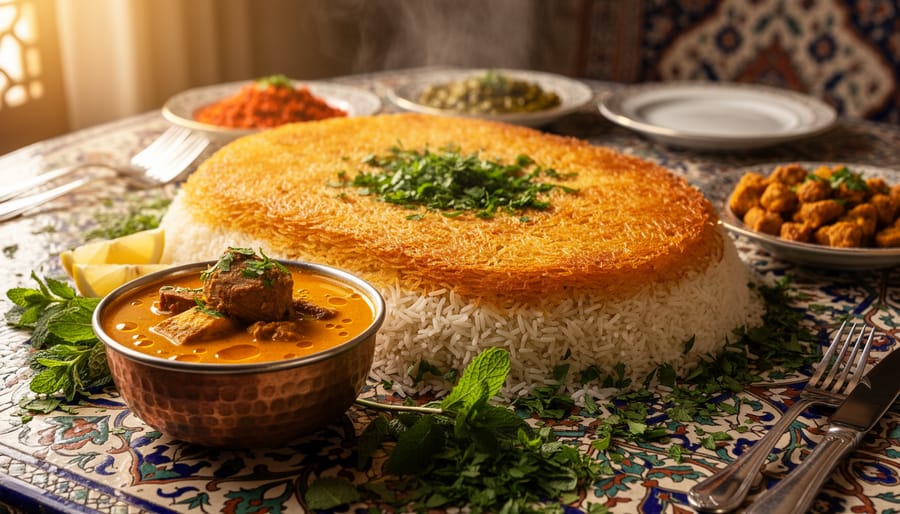
At its heart, Persian cooking revolves around rice prepared with care, often crowned with tahdig, the golden crust every Persian cook aims to perfect. Stews called khoresh simmer slowly with meat, vegetables, and fruits like pomegranate or quince, while kebabs showcase the simplicity of quality ingredients cooked over fire. Saffron threads steep in hot water to release their color and perfume. Dried limes, barberries, and rose petals appear where you might not expect them, each ingredient chosen to create harmony on the plate.
- Tahdig
- The crispy, golden rice crust formed at the bottom of the pot, considered the most prized part of any Persian rice dish.
- Polo
- Persian-style rice, often layered with herbs, vegetables, or meats and steamed until fluffy with a crispy bottom.
- Khoresh
- A category of slow-cooked stews that combine meat, vegetables, fruits, and spices, served over rice.
- Advieh
- A fragrant Persian spice blend typically containing cinnamon, cardamom, cumin, and rose petals, varying by region and family recipe.
What sets Persian food apart from broader Middle Eastern cuisine is this particular approach to balance and the central role of rice. While neighboring cuisines favor bread as the staple, Persians elevated rice preparation to an art form. The flavor profile leans toward delicate complexity rather than heat or heaviness. Where Turkish food might emphasize yogurt and grilled meats, and Arab cuisines highlight tahini and chickpeas, Persian cooking weaves fruit into savory dishes and uses herbs by the handful, not the pinch. It’s a distinct culinary voice that speaks of Persia’s position as a crossroads of civilizations, absorbing influences while maintaining its own clear identity.
Ancient Roots: Where Persian Cuisine Began
When I first learned that Persian cuisine predates most of the world’s great culinary traditions by thousands of years, I was standing in a museum, staring at a 2,500-year-old clay tablet. The tablet documented royal banquet menus from the Achaemenid Empire, listing ingredients we’d recognize today: saffron, pomegranates, almonds, dates. That moment shifted how I understood Persian food. This wasn’t just ancient cooking, it was sophisticated gastronomy when most of Europe was still roasting meat over open fires.
The Achaemenid Empire, which ruled from roughly 550 BCE to 330 BCE, established dining customs that would define Persian cuisine for millennia. King Darius the Great maintained a court so elaborate that royal cooks numbered in the hundreds, each specializing in specific dishes. Archaeological digs at Persepolis have uncovered kitchen complexes with clay ovens, grain storage systems, and evidence of advanced food preservation techniques. These weren’t simple cooking spaces. They were culinary laboratories where cooks experimented with flavors from across the known world.
What strikes me most is how the empire’s vast reach shaped its food. Stretching from Egypt to India, Persia sat at the crossroads of the ancient spice trade routes. Cinnamon from Ceylon, cardamom from India, cumin from the Mediterranean, all flowed through Persian markets. Court cooks didn’t just use these spices. They developed sophisticated combinations that balanced heat, sweetness, and aromatics in ways that felt revolutionary.
Here’s where it gets personal for me: the Persian invention of agrodolce, the sweet-sour balance that defines so much of the cuisine. Ancient texts describe dishes combining honey with vinegar, or dates with sour grape juice. This wasn’t accidental. Persian physicians and philosophers believed contrasting flavors created harmony in both food and body. When you taste a modern fesenjan, chicken in pomegranate-walnut sauce, you’re experiencing a flavor principle born in these ancient kitchens.
The empire eventually fell, but its culinary legacy didn’t. Those techniques, that philosophy of balance, survived through generations of home cooks and court chefs who carried the knowledge forward.
How Persian Food Works: The Philosophy Behind the Flavors
The Art of Balance
Persian cooks don’t just throw ingredients together, they orchestrate them. Every dish aims for a precise equilibrium that satisfies multiple senses at once, a practice refined over millennia.
The sweet-sour tension defines countless classics. Pomegranate molasses cuts through the richness of braised lamb, while saffron threads add floral sweetness to rice. Fesenjan, the walnut-pomegranate stew, exemplifies this: ground walnuts provide earthy depth, pomegranate creates tart brightness, and a whisper of sugar rounds the edges. The result tastes complex yet cohesive, never one-note.
Fresh versus dried ingredients creates another layer. Heaps of fresh herbs, parsley, cilantro, dill, appear alongside dried limes that contribute concentrated citrus funk. Ghormeh sabzi relies on this contrast: vibrant greens meet sun-dried fenugreek and pierced limoo omani, which release their intense flavor during hours of simmering.
Texture matters just as much. The golden tahdig crust at the bottom of the rice pot offers satisfying crunch against pillowy grains above it. Shared Persian meals often feature soft stews alongside crisp pickles, tender kebabs with crunchy raw onion, creamy yogurt beside crunchy cucumber. Each bite invites contrast, preventing palate fatigue and keeping diners engaged throughout the meal. This deliberate balancing act transforms simple ingredients into sophisticated experiences.
Ceremonial Significance
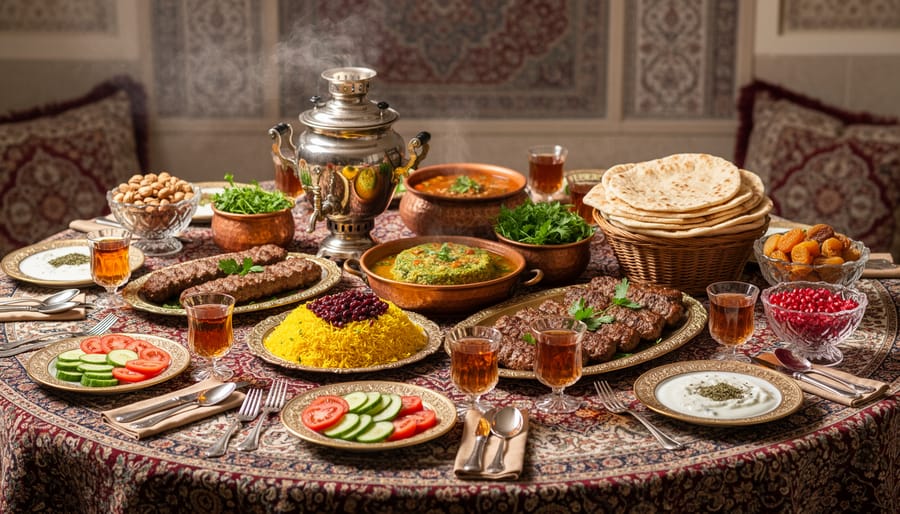
Persian meals carry weight beyond nutrition. When families gather around a sofreh, the traditional cloth spread on the floor or table, they’re enacting a ritual that dates back millennia. The arrangement itself tells a story: bread placed at cardinal points to honor the earth, salt for prosperity, fresh herbs for renewal. During Nowruz, the Persian New Year, the haft-seen table displays seven symbolic items beginning with the letter ‘S’ in Farsi, each representing hope for the coming year. Sabzi polo ba mahi (herb rice with fish) isn’t just dinner; it’s an edible prayer for abundance.
Persian hospitality transforms strangers into honored guests through food. The tradition of “taarof”, the complex dance of offering and refusing, reaches its peak at the dining table, where hosts insist you eat more long after you’re full. This isn’t mere politeness. Sharing saffron-scented rice or pomegranate stew bonds people in ways conversation alone cannot. Ancient Persians believed feeding someone created a spiritual debt of goodwill. That philosophy survives today, making every Persian meal a small ceremony of connection.
Evolution Through the Ages: Key Historical Milestones
Persian cuisine didn’t emerge fully formed. It evolved through centuries of conquest, trade, and cultural exchange, each era leaving its mark on the flavors we recognize today.
The Sassanian Empire (224-651 CE) transformed Persian food from sustenance into art. Royal kitchens employed hundreds of cooks who perfected techniques still used in Iranian homes: the crispy tahdig on rice, the slow-braising of stews, the delicate layering of herbs. Court records describe elaborate banquets with dozens of courses, where dishes like sikbaj, a sweet-and-sour meat stew with vinegar and honey, set the template for modern khoresh. My grandmother used to say that every time she made fesenjan, she was cooking a dish that Sassanian nobles would recognize, even after fourteen centuries.
The Islamic Golden Age (8th, 13th centuries) brought new ingredients and scientific precision to Persian cooking. Arab caliphs in Baghdad employed Persian chefs who introduced refined sugar, rice cultivation techniques, and the first written cookbooks. The 10th-century “Kitab al-Tabikh” contains recipes that read remarkably like contemporary Persian dishes. This period also saw the widespread adoption of distillation, giving Persian cooks access to rosewater and other floral essences that became signature flavors.
The Mongol invasion (13th century) initially devastated Persian agriculture, yet it opened new culinary pathways. Central Asian nomads brought dumplings that evolved into ash-e reshteh, introduced yogurt-based preservation methods, and merged their grilling traditions with Persian spice techniques to create what we now know as Persian kabab culture.
Here’s how major dynasties shaped the cuisine we know today:
- Sassanian Era (224-651 CE): Established sophisticated court cuisine, perfected rice cooking, developed sweet-sour flavor balancing
- Islamic Golden Age (8th, 13th centuries): Introduced refined sugar, wrote first Persian cookbooks, expanded spice repertoire through trade
- Mongol Period (13th, 14th centuries): Added Central Asian techniques, influenced dumpling and noodle dishes, transformed meat preparation methods
- Safavid Dynasty (1501-1736): Created elaborate multi-course meals, elevated saffron usage, established tea culture, refined rice artistry
- Qajar Era (1789-1925): Introduced European ingredients like tomatoes and potatoes, formalized recipe documentation, created fusion dishes
The Safavid period represents Persian cuisine’s golden age. Shah Abbas I’s court in Isfahan became legendary for its culinary sophistication. Chefs competed to create increasingly elaborate rice dishes, giving birth to jeweled rice studded with barberries, pistachios, and candied orange peel. The ceremonial importance of food reached new heights, meals became theater, with specific dishes marking seasons and celebrations.
The Qajar dynasty brought Persian food into the modern era. European influences introduced tomatoes, which transformed stews like ghormeh sabzi. Potatoes found their way into kuku. Yet Persian cooks didn’t simply adopt foreign ingredients, they persianized them, wrapping new flavors in ancient techniques and philosophy. When I taste kotlet, those crispy Persian meat patties, I’m tasting this cultural dialogue between tradition and adaptation.
This layered history explains why Persian food feels simultaneously ancient and contemporary, familiar yet exotic. Each dish carries echoes of the empires, merchants, and home cooks who shaped it across millennia.
Essential Components: What Makes a Dish Persian
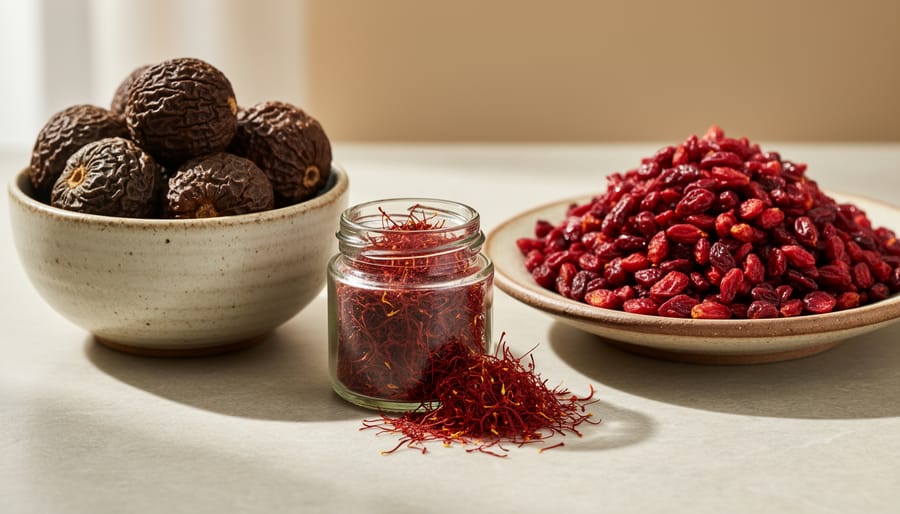
Walking into a Persian kitchen, you’ll encounter ingredients and techniques that have remained remarkably consistent for centuries, each serving a specific purpose in creating that unmistakable Persian flavor. These building blocks aren’t arbitrary; they’re the carefully honed elements that transform simple ingredients into the signature Persian dishes that have captivated diners for millennia.
- Saffron (Za’faran)
- The golden threads that provide Persian food’s distinctive color and perfume, bloomed in hot water before adding to dishes. Used in rice, stews, and teas, it’s considered the soul of Persian cooking.
- Dried Limes (Limoo Amani)
- Sun-dried limes that add a complex sour-bitter depth to stews and rice. Pierced with a fork before use, they release an unmistakable tangy aroma during slow cooking.
- Barberries (Zereshk)
- Tiny tart berries that provide bursts of acidity and jewel-like color when scattered over rice dishes. Briefly sautéed with a pinch of sugar to balance their natural sourness.
- Pomegranate (Anar)
- Used both as fresh seeds and concentrated molasses, it delivers the characteristic sweet-sour balance in stews like fesenjan. The molasses is essentially Persian umami.
- Fresh Herbs (Sabzi)
- Not garnishes but main ingredients, used in massive quantities. Parsley, cilantro, dill, mint, fenugreek, and tarragon appear in combinations specific to each dish type.
Beyond individual ingredients, Persian cooking relies on techniques that can’t be rushed. Rice preparation follows an elaborate multi-step process: soaking, parboiling, then steaming with a cloth-wrapped lid to create fluffy grains topped with tahdig, the golden crust that’s the most coveted portion. This isn’t just cooking rice; it’s practicing an art form passed down through generations.
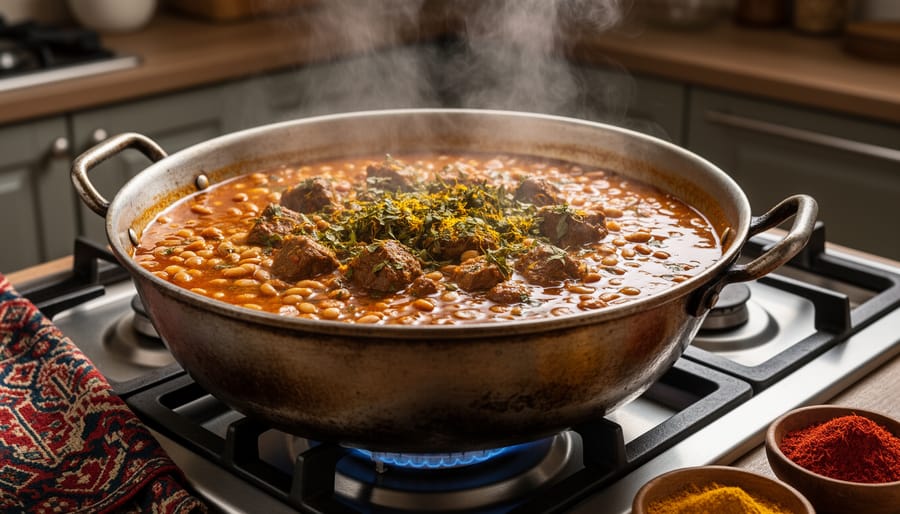
Slow-braising defines the khoresh category of stews, where meat simmers for hours with herbs, vegetables, and souring agents until flavors meld into something far greater than their parts. The Persians understood what modern chefs rediscover: time is an ingredient. Meanwhile, kabab preparation involves specific meat cuts, traditional marinades (often yogurt-based with saffron), and exact grilling techniques over charcoal.
The structural categories themselves tell stories. Polo refers to rice dishes that can stand alone as meals, layered with proteins, vegetables, or dried fruits. Khoresh are those slow-cooked stews always served over plain rice. Ash describes thick, nourishing soups packed with legumes and herbs. And alongside these, Persian side dishes like torshi (pickled vegetables) and mast-o khiar (yogurt with cucumber) provide contrasting textures and flavors that complete the meal experience. Master these components, and you begin to understand how Persian cooks think about building flavor.
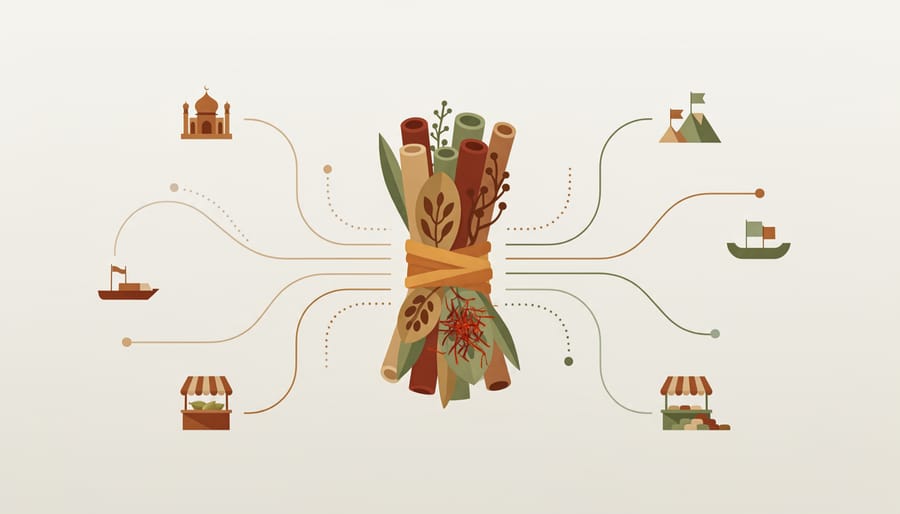
How Persian Cuisine Traveled the Silk Road
The caravans that snaked across the Silk Road carried more than silk and spices, they transported the essence of Persian kitchens to distant lands. From the 2nd century BCE onward, merchants, diplomats, and conquerors became unwitting ambassadors of Persian culinary techniques, introducing the world to sophisticated flavor combinations that would reshape regional cuisines permanently.
Persian rice cultivation methods traveled east into Central Asia, where pilaf became a staple from Uzbekistan to Afghanistan. The intricate layering techniques and aromatic spicing that define Persian fine dining influenced Mughal court cuisine in India, where dishes like biryani echo Persian polo traditions. The Mongol invasions, though devastating, paradoxically spread Persian cooking northward, conquering armies adopted Persian court chefs, who brought their knowledge to new imperial kitchens.
Westward, the story gets equally fascinating. When the Moors ruled medieval Spain, they brought Persian agricultural innovations and cooking methods absorbed during their time in North Africa and the Middle East. The European fondness for sweet-savory combinations in dishes like agrodolce can be traced back to Persian influence filtering through Islamic Iberia. Saffron cultivation in Spain, almonds in sweets, and rice dishes like paella all carry faint echoes of Persian techniques introduced centuries ago.
The Ottoman Empire absorbed substantial elements of Persian cuisine after centuries of rivalry and cultural exchange along shared borders. Turkish dishes like hünkar beğendi and countless kebab variations show clear Persian ancestry, adapted and transformed but retaining that fundamental approach to balancing flavors.
Today’s global interest in authentic Persian dining represents a modern chapter in this ancient story, one where the food travels not by caravan but through passionate chefs and curious diners rediscovering these time-tested traditions. The Silk Road may be gone, but Persian cuisine’s journey across cultures continues.
The Global Appeal of Persian Food Today
Walk into any major food city in 2026, London, Los Angeles, Sydney, Toronto, and you’ll likely spot a Persian restaurant that didn’t exist five years ago. This isn’t a coincidence. Persian cuisine has shifted from niche ethnic food to a culinary trend that food critics and home cooks alike can’t stop talking about.
The reasons behind this surge are surprisingly practical. While Western palates have spent years chasing bold, often one-dimensional flavors, Persian food offers something different: complexity without heaviness. A single bite of fesenjan delivers pomegranate’s tartness, walnut’s earthiness, and chicken’s tenderness in perfect harmony. Health-conscious diners appreciate that many traditional dishes rely on lean proteins, abundant herbs, and minimal processed ingredients. Saffron rice with grilled kabab isn’t just delicious, it’s also naturally gluten-free and packed with fresh vegetables.
Instagram and TikTok have become unexpected ambassadors for Persian food culture. The visual drama of tahdig, that golden, crispy rice crust, photographs beautifully and consistently goes viral. Food influencers film themselves cracking through the crunchy layer, and suddenly millions of viewers want to know where they can try it. Jeweled rice studded with barberries and pistachios looks like edible art, and the theatrical presentation of a whole saffron-steamed fish or a towering mound of dill rice creates shareable moments that algorithm-friendly content thrives on.
Global food enthusiasts are drawn to Persian cuisine in 2026 for several compelling reasons:
- Sophisticated flavor balancing that rewards adventurous eaters seeking depth beyond basic spice heat
- Vegetarian and vegan options that predate modern diet trends by centuries (herb stews, eggplant dishes, legume-based meals)
- The slow-food philosophy embedded in traditional cooking methods, appealing to those rejecting fast-casual dining
- Cultural storytelling that connects each dish to Persian poetry, festivals, and family rituals
- Minimal use of dairy and wheat in many dishes, aligning with contemporary dietary preferences
What truly sets Persian restaurants apart in this moment is their ability to feel both exotic and familiar. The dining experience isn’t intimidating, rice and grilled meat form the foundation, making it accessible to cautious eaters, but the flavor combinations introduce something genuinely new. A first-timer might order a safe-sounding kabab and discover the revelation of sumac’s citrusy bite or the floral notes of rose water in dessert.
Celebrity chefs have noticed. High-profile restaurants now feature Persian-inspired dishes on tasting menus, bringing techniques like slow-braising with dried limes into fine dining conversations. Cookbook publishers report strong sales for Persian culinary titles, and cooking classes teaching rice preparation or stew-making consistently sell out. The cuisine has reached that sweet spot where it feels both timeless and trendy, rooted in ancient tradition yet perfectly suited to how people want to eat right now.
Common Questions About Persian Food History
Readers curious about Persian cuisine often wonder about its nomenclature, reach, and unique characteristics. These questions reveal the natural confusion between cultural terms, culinary boundaries, and the historical threads connecting ancient Persia to modern kitchens.
Is Persian food the same as Iranian food?
Yes, Persian food and Iranian food refer to the same culinary tradition. “Persian” honors the historical and cultural heritage, while “Iranian” reflects the modern nation’s name since 1935.
How did Persian cuisine influence other cultures?
Persian cooking techniques and ingredients spread through the Silk Road, influencing Indian biryanis, Turkish pilafs, and even medieval European dishes through Moorish Spain. The concept of combining meat with fruit in savory dishes traveled from Persian courts across three continents.
What’s the oldest Persian dish still eaten today?
Abgoosht (lamb and chickpea stew) traces back thousands of years as a fundamental Persian dish, though ancient fesenjan, chicken in pomegranate-walnut sauce, appears in texts from the Sassanian period and remains virtually unchanged.
Why is rice so important in Persian cuisine?
Rice cultivation reached Persia around 1,000 BCE and became central to Persian identity through elaborate preparation methods like tahdig and the ceremonial importance of sharing polo at gatherings.
What makes Persian food different from Arab or Turkish cuisine?
Persian cuisine emphasizes the sweet-sour balance and extensive use of fresh herbs, while Arab cooking tends toward spice blends like baharat and Turkish food focuses on grilled meats and yogurt-based dishes. The Persian tradition of slow-braised stews with fruit sets it apart from its neighbors.
Understanding these distinctions helps food enthusiasts appreciate Persian cuisine as a distinct culinary tradition with its own philosophy and techniques. The confusion often stems from geographical proximity and shared ingredients across the region, yet the approach to balancing flavors and the cultural rituals surrounding food mark Persian cooking as uniquely sophisticated. When you taste a properly made khoresh, with its layers of sweet pomegranate against savory lamb and the brightness of fresh herbs, you’re experiencing a flavor profile that developed independently over millennia, one that neighboring cuisines borrowed from but never quite replicated in the same way.
From the royal courts of ancient Persia to your table today, this culinary tradition has endured because it represents something deeper than recipes, it’s a living expression of hospitality, balance, and cultural pride that continues to evolve while honoring its roots.
When you taste authentic Persian food, you’re experiencing the same principles of flavor harmony that delighted Achaemenid kings, the ceremonial importance of shared meals that defined Sassanian gatherings, and the sophisticated techniques refined over millennia. The saffron-scented rice, the sweet-sour dance of pomegranate and herbs, the slow-braised tenderness of a perfectly executed khoresh, these aren’t museum pieces. They’re vibrant traditions carried forward by generations who understood that food creates connection.
At Taste of Persia, we honor this heritage not by freezing it in time but by keeping it alive. Every dish we serve draws on centuries of culinary wisdom while speaking to contemporary tastes and dietary preferences. We invite you to explore this rich history firsthand, whether through our restaurant experience or the stories and insights we share here.
Persian cuisine has traveled from ancient empire to global phenomenon because it offers what people have always sought, beautiful, nourishing food that brings people together. That journey continues with each meal shared, each tradition passed down, each new friend welcomed to the sofreh. Come discover why Persian hospitality has captivated the world for thousands of years.