Persian hospitality, known as mehmaan-navazi, is the centuries-old cultural practice of welcoming guests with profound generosity, warmth, and an abundance of food that transforms every visit into a celebration. At its heart lies a simple belief: a guest is a gift from God, and honoring them through lavish spreads, endless tea, and genuine care is both a spiritual duty and a source of pride for the host.
I grew up watching my grandmother prepare for visitors days in advance, her kitchen filling with the aroma of saffron rice and slow-cooked stews. The sofreh, that cloth spread on the floor laden with more dishes than anyone could possibly eat, wasn’t about excess. It was her language of love, her way of saying you matter here without uttering a word.
This tradition runs deeper than simply offering food. Persian hospitality operates through unspoken rituals like ta’arof, a dance of polite insistence where hosts offer repeatedly and guests initially refuse, creating a rhythm of respect that can bewilder outsiders but feels like poetry to those who understand it. The practice shapes everything from how you enter a home to how you leave, with hosts often walking guests to the street corner and watching until they disappear from view.
Understanding Persian hospitality means recognizing that the table is never just a table. It’s a stage where culture, history, and affection converge, where abundance signals not wealth but the depth of welcome extended to everyone who crosses the threshold.
The Sacred Tradition of Mehmaan-Navazi
The word “mehmaan-navazi” translates roughly to “guest-cherishing,” but that definition barely scratches the surface of what it means in Persian culture. This isn’t about being polite or following social etiquette. It’s a spiritual practice, a moral duty, and a source of personal honor that has shaped Persian society for millennia.
In Persian tradition, a guest is considered “mehman-e Khodā”, a guest of God. When someone crosses your threshold, they carry divine blessing with them. This belief transforms hospitality from a social nicety into something sacred. You don’t just welcome a guest because it’s the right thing to do; you welcome them because they represent an opportunity to serve something greater than yourself.
This mindset explains why Persian hosts can seem almost overwhelming in their generosity. They’re not trying to impress you or show off their wealth. They’re honoring a tradition that predates modern Iran by centuries, one that sees the act of feeding and caring for others as a reflection of your character and your relationship with the divine.
Ancient Persian texts, including the teachings of Zoroastrianism, emphasized generosity and care for travelers as fundamental virtues. When Persia sat at the crossroads of the Silk Road, offering shelter and sustenance to strangers wasn’t just charitable, it was essential to the functioning of society. That practical necessity evolved into a cultural identity that persists today.
Even in modern Persian households, whether in Tehran or Toronto, this tradition remains unshakeable. The reverence for guests hasn’t diminished with time or distance from the homeland. If anything, Persians living abroad often hold even more tightly to mehmaan-navazi as a way of preserving their cultural soul.
The Sofreh: More Than Just a Tablecloth
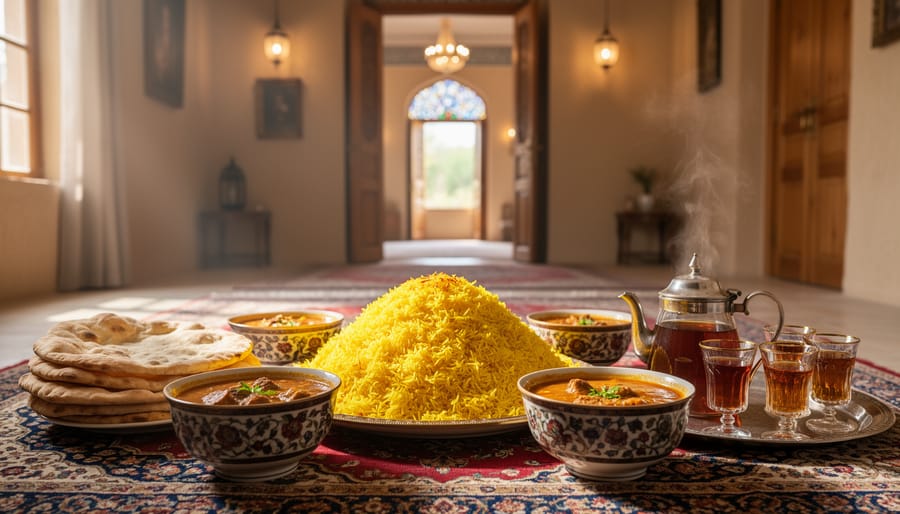
The sofreh is where Persian hospitality takes physical form. Long before the first dish arrives, a Persian host spreads this cloth, often intricately patterned or embroidered, across the floor or table, transforming any space into a sanctuary of welcome. What appears to be simply a tablecloth is actually a canvas upon which generosity, abundance, and care will be displayed.
Preparing the sofreh is a deliberate act of devotion. A Persian host considers not just what food to serve, but how it will look when arranged together, the colors, the heights, the visual harmony of dishes that will greet the guest’s eyes. Fresh herbs glisten in bowls. Flatbread is folded just so. Even the placement of salt and pepper becomes meaningful.
This careful staging communicates a profound message: you matter enough for me to create beauty for you. The sofreh says “I anticipated your arrival with joy” before a single word of greeting is spoken. Unlike Western tables set with individual place settings that delineate personal space, the sofreh invites everyone to gather around a shared center, literally bringing people closer together.
In Persian homes, you’ll often see special sofrehs reserved exclusively for guests, fabrics too precious for everyday use, brought out only when company arrives. This distinction reinforces that your presence has elevated an ordinary day into an occasion worthy of the family’s finest things.
The Ritual of Tea and Sweets
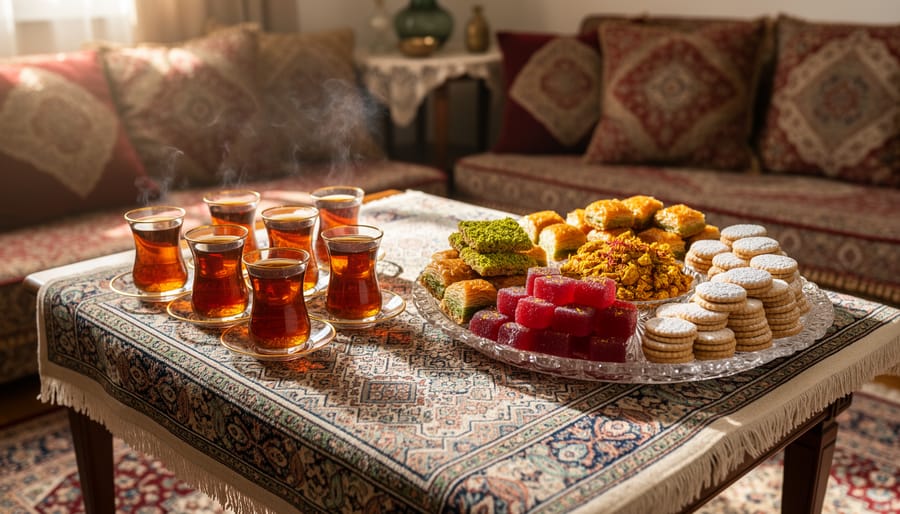
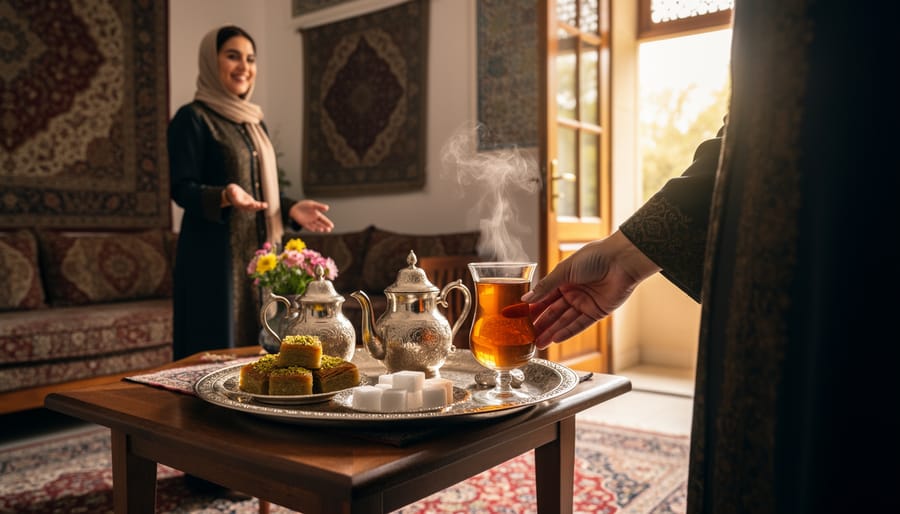
The moment you step through the door of a Persian home, before you’ve even removed your shoes, the ritual begins. Your host will guide you to a seat and within minutes, often seconds, a steaming glass of tea and a plate of sweets will appear before you. This isn’t merely refreshment; it’s the opening gesture of a sacred contract between host and guest.
The tea itself carries meaning. Served in small, delicate glasses that let you admire its amber color, Persian tea (chai) is brewed strong and typically sweetened with a sugar cube held between the teeth as you sip. The warmth of the glass in your hands, the fragrance of the tea, these sensory details signal that you are welcome, that your presence matters, that you have entered a space of care.
The sweets accompanying the tea are chosen deliberately to honor you. You’ll likely encounter:
- Baklava, layers of phyllo with pistachios and honey
- Gaz, a nougat confection from Isfahan studded with pistachios
- Noghl, sugar-coated almonds that symbolize celebration
- Sohan, a saffron brittle with butter and pistachios
- Tut, mulberry-shaped marzipan treats
Refusing this initial offering is nearly impossible without causing genuine distress to your host. Even if you’ve just eaten, even if you don’t typically drink tea, accepting this gesture is essential. To decline is to reject the foundation of Persian hospitality itself, the offer of comfort and the desire to nourish you, body and spirit, from the moment you arrive.
Ta’arof: The Dance of Polite Insistence
If you’re new to Persian gatherings, prepare yourself for ta’arof, a ritual of polite refusal and insistence that plays out around every dish, every cup of tea, every second helping. Your host will urge you to eat more. You’ll politely decline. They’ll insist again, perhaps placing food on your plate themselves. You’ll protest. They’ll pour more tea anyway.
This isn’t mere politeness. Ta’arof is a deeply embedded social dance in Persian culture, a way of showing respect and humility while simultaneously demonstrating generosity. When your host says “befarmaid” (please, help yourself), they genuinely mean it, even if you’ve already eaten three servings. The custom requires them to offer repeatedly, and it requires you to refuse at least once or twice before accepting, though with food, acceptance is ultimately expected.
For outsiders, the confusion is real. How many refusals are enough? When should you actually accept? The answer lies in reading the situation. If your host keeps filling your plate despite your protests, let them. If they insist a third time, accept graciously. Refusing too adamantly can actually offend, suggesting you find their hospitality insufficient.
The key is understanding that ta’arof around food isn’t about what you say, it’s about participating in a ritual that honors both giver and receiver. Your host shows generosity through insistence. You show respect through initial refusal, then gratitude through eventual acceptance. It’s complicated, yes, but it’s also a beautiful expression of Persian values where hospitality means never letting a guest feel unwelcome or unfed.
Abundance as Love Language
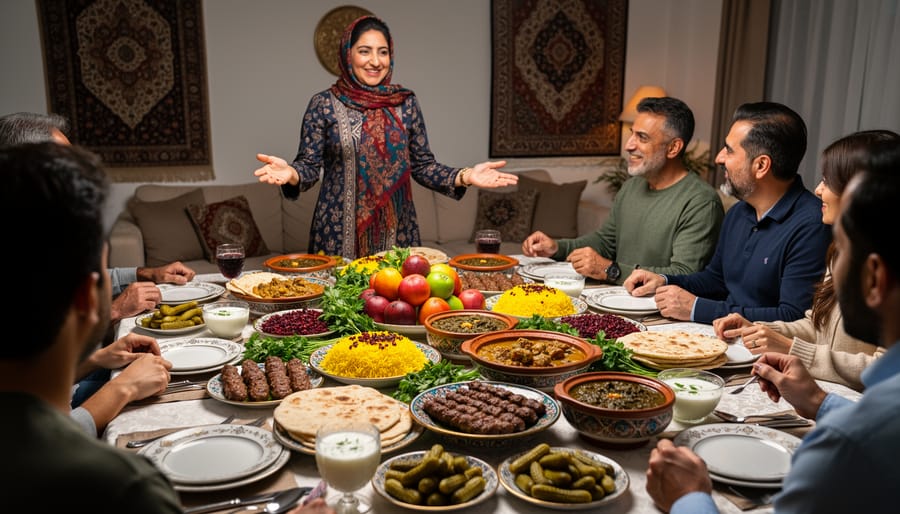
In Persian culture, the sheer volume of food on the table isn’t about excess, it’s about expressing love in the most visible way possible. A host will prepare enough to feed twice as many people as expected, ensuring that no guest ever feels there isn’t plenty to go around. This generosity stems from a deeply held belief that abundance reflects the warmth of the host’s feelings.
The moment a serving dish looks even slightly depleted, a Persian host will rush to refill it or add extra dishes to the spread. Guests should never glimpse an empty platter because that visual emptiness contradicts everything Persian hospitality stands for. The table must overflow, demonstrating that your presence is so valued that nothing was held back in your honor.
This philosophy runs counter to Western notions of measured portions and minimizing waste. For Persians, the unfinished dishes aren’t failures; they’re proof that the host provided generously enough that no one could possibly go hungry. The leftovers tell the story: your guests were genuinely satisfied, not because the portions were calculated, but because they were overwhelmed with choices. It’s a love language written in rice, stews, and endless platters, one that says “you matter enough for me to give you everything I have.”
Signature Dishes of Persian Welcome
When a Persian host decides to honor you with a meal, certain dishes appear again and again, not by accident, but because of what they represent. These are the signature Iranian dishes that communicate respect, skill, and deep care.
Chelow kabab, the national dish of Iran, tops nearly every list. The preparation of perfectly fluffy saffron rice with its prized tahdig (crispy bottom layer) alongside tender, charcoal-grilled meat demonstrates both technical mastery and patience. A host who serves you flawless tahdig is showing off their culinary prowess while giving you the best part.
Ghormeh sabzi, the herb stew that takes hours of careful preparation, tells guests they’re worth the effort. The slow simmering of fresh herbs with kidney beans and lamb creates layers of flavor that can’t be rushed. When someone serves you this dish, they started cooking long before you arrived.
Fesenjan, the walnut and pomegranate stew, brings both luxury and symbolism to the table. Pomegranates represent abundance and fertility in Persian culture, while the labor-intensive sauce, ground walnuts simmered until they release their oils, shows dedication to craft. This is a dish reserved for honored guests.
The Persian side dishes surrounding these mains matter just as much. Mast-o khiar (yogurt with cucumber), torshi (pickled vegetables), and sabzi khordan (fresh herb platter) aren’t afterthoughts. They balance the meal and showcase the host’s attention to detail and variety.
Then there’s polo, rice dishes mixed with ingredients like dill and broad beans, barberries, or lentils and dates. Each variation requires specific techniques passed down through generations. The crunch of the tahdig, the aroma of saffron, the balance of sweet and savory, these elements prove the host has learned their craft well and considers you worthy of their finest work.
Creating Persian Hospitality in Your Own Home
You don’t need to master authentic Persian cuisine to bring mehmaan-navazi into your own home. The essence of Persian hospitality lies in the warmth you create, not perfection in the kitchen.
Start with these foundational practices:
- Greet guests with tea and something sweet immediately upon arrival, before they even sit down. This signals that their presence matters more than any schedule.
- Prepare more than you think you’ll need. Abundance isn’t wasteful in this context, it’s a visual expression that your guests deserve plenty.
- Set your table or spread with intention. Even simple dishes look generous when arranged with care on a beautiful cloth or platter.
- Insist warmly when offering seconds. The gentle persistence of ta’arof makes guests feel genuinely wanted, not merely tolerated.
- Focus on dishes you can make ahead, so you’re present with your guests rather than stressed in the kitchen.
The spirit matters more than the specifics. A pot of herbed rice, a simple stew, flatbread, and fresh herbs create a Persian atmosphere when served with genuine attention to your guests’ comfort. Keep the tea flowing, never let anyone’s plate look empty, and remember that in Persian hospitality, making someone feel valued is the real recipe.
The next time you sit down to a meal prepared by Persian hands, pay attention to what’s happening beyond the plates. You’re witnessing a tradition that has survived empires, migrations, and millennia because it speaks to something fundamental about being human. Persian hospitality through food isn’t about impressing guests with expensive ingredients or elaborate presentations. It’s about communicating a simple message: you matter, your presence brings us joy, and we want you to feel at home.
Every dish placed before you carries that message. Every insistence that you eat more comes from genuine care. The abundance, the ritual, the beautiful presentation of the sofreh all serve one purpose: making you feel valued and seen.
You don’t need a Persian grandmother or years of cooking experience to embrace this spirit. Start with what you have. Make your guests comfortable. Serve with generosity. Refuse to let anyone leave hungry or feeling like a burden.
At Taste of Persia, we bring this tradition to every table. When you dine with us, you’re not just trying new flavors. You’re experiencing mehmaan-navazi the way it’s been practiced for generations, where every guest is treated like family and every meal is an act of welcome.